
Understanding Alopecia Areata
Understanding Alopecia Areata
Introduction
Alopecia Areata: What It Is and Why It Happens Suddenly
Alopecia areata is an autoimmune condition where your body's own immune cells attack the hair follicle, causing localised patches of hair loss. It may present with a single patch or multiple patches and can evolve slowly or very rapidly, occurring almost overnight. It is actually quite a common condition, with an estimated 400,000 people in the UK suffering with alopecia. It is a specific hair loss disease that is very different from pattern hair loss with ageing. And in contrast with other types of hair loss, the actual hair follicle remains intact and can regrow hair once the condition is under control or has resolved.
Is It Alopecia Areata? Recognising the Signs
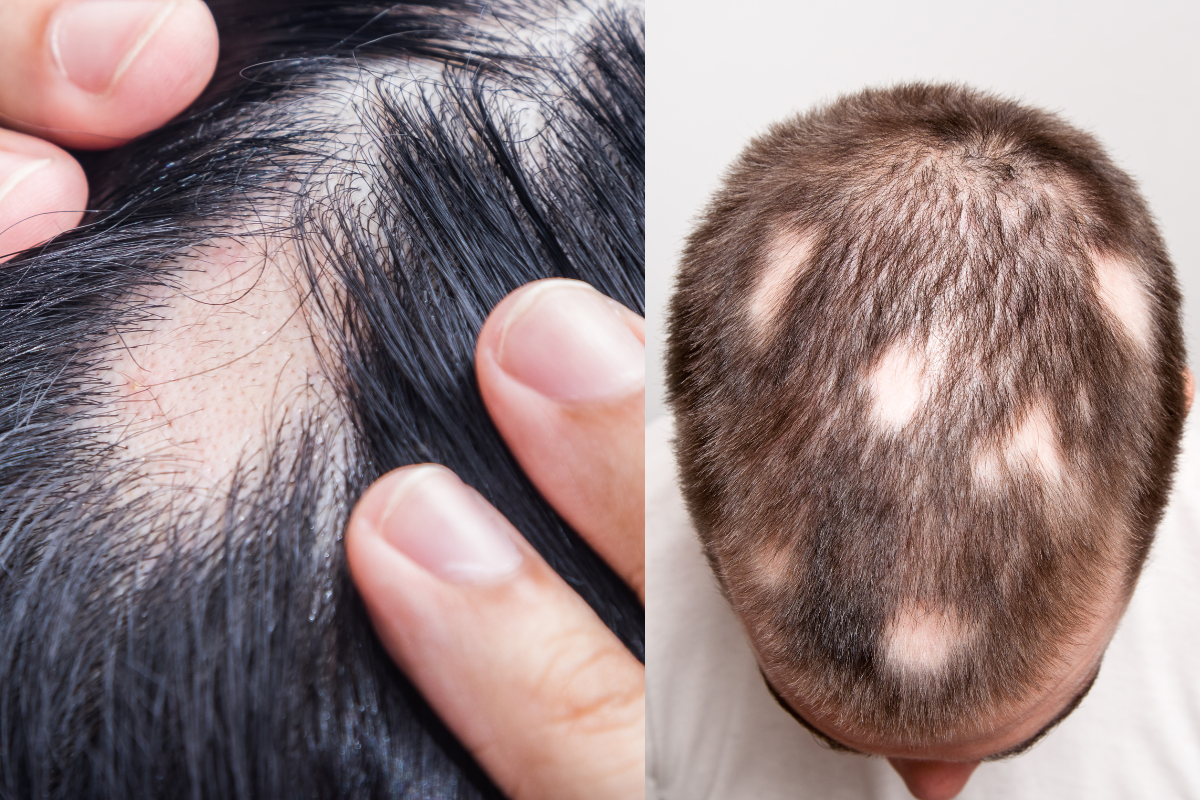
The most typical presentation of alopecia is a smooth bald patch, usually on the scalp or several smooth patches. These can spread outwards, starting relatively small, like a 10p size, and progress to large patches that can be palm sized or bigger. Patches can merge into one another, and the condition can progress to total scalp loss or total hair loss, including the eyebrows, eyelashes, and body hair.
Presentation
The Different Patterns of Alopecia: Patchy, Totalis and Universalis Explained
Alopecia has three different names that can be quite confusing. The commonest name is alopecia areata, which typically refers to patches of hair loss. The other terms used are alopecia “totalis” and “universalis”, and sometimes there is a misconception that these are different diseases. They are in fact all the same process, but the different words relate to the different patterns. Areata refers to patches of hair loss, totalis refers to total scalp loss, and universalis refers to total scalp and loss of body hair, including eyebrows, eyelashes, nasal hair, and limb hair.
Alopecia areata may be seen as the more milder end of the disease and some people will only have this particular pattern. Alopecia areata may remain localised and may never progress to a more widespread form. It is very common for this pattern to spontaneously regrow hair within a number of months. Alopecia totalis and universalis are seen as much more severe types of alopecia. Here, the chance of spontaneous regrowth is considerably less.
There are other terms that you may hear of, such as an “ophiasis” pattern. This is where alopecia involves the area behind the ears and along the occipital hairline in a pattern that is supposed to be snake-like. This is a stubborn pattern that is also quite resistant to treatment.
Beyond the Scalp: Nail Changes and Other Signs of Alopecia Areata
Alopecia areata can affect localised areas like the eyebrows and eyelashes, leading to partial loss or total loss of these areas. This can have a very profound impact on self-esteem, as the eyebrows in particular frame the face and without them our appearance is much altered. Eyelashes also serve an important function from keeping dust and debris out of the eye. Loss of the protection from lashes can lead to eye irritation. Alopecia can affect the nails with nail pits or rough nails developing. These changes are often seen in more severe cases of alopecia. Patches of hair loss on the limbs or in the axillary or suprapubic area are also quite common.
What Doctors Look For: Exclamation Mark Hairs and Other Diagnostic Clues
A dermatologist will often examine the scalp with a magnifying device called a dermatoscope. These vary in strength from 10 to 20 times with special lights that allow close observation of the skin. The most typical feature of alopecia is a broken hair called an exclamation mark hair. This is where the hair snaps off quite close to the skin surface and tapers as the hair leaves the skin. Sometimes these hairs break at the skin surface and this causes a different feature called black dots. Hair follicles that are no longer growing a hair can become plugged with keratin or sebum, and this creates another feature called yellow dots. Sometimes hairs can start to regrow, and these are often coiled tight, referred to as circle or pigtail hairs. This is a positive sign of recovery.
Pathology and Causes
The Immune System and Hair Loss: How Alopecia Areata Actually Works
In normal health, the hair follicle structure is classed as an immune privileged site, which means that your immune system does not normally recognise it as anything to worry about. We don't entirely know why it is an immune privileged site, but we know that loss of immune privilege is a precursor to the immune system attacking the hair. I often explain this to patients like there is a force field around the hair that prevents your immune system from really seeing the hair and this is lost. The hair follicle then starts waving danger signals to the immune system and the immune system does what it's supposed to, which is attack when it sees these danger signals. Once your own body's white blood cells start attacking the hair, they produce more signals that attract more white cells and so the attack goes on and on and on. If the immune system sorts itself out, then the hair follicle can go back to normal and start regrowing another hair.
Is Alopecia Areata Genetic? Understanding Risk Factors and Family History
Alopecia areata is not inherited like typical inherited conditions, but the tendency to get an autoimmune condition can be inherited. For children and younger adults, it is highly likely that they have this genetic predisposition that they have inherited, and then a trigger event happens that causes the localised patches of hair loss. If a parent has alopecia there is between a 1in 10 and 1 in 20 chance that their children may also have alopecia. The genetic predisposition to autoimmune conditions also explains why other autoimmune conditions may be more common, such as coeliac disease, inflammatory bowel disease, pernicious anaemia, type 1 diabetes, vitiligo, and thyroid disease. Other risk factors include atopy or the tendency to eczema, asthma, and hay fever.
Can Stress Cause Alopecia Areata?
It is thought that severe stress can be one of the trigger events, but we don't entirely understand the mechanism. When you are stressed, you produce a neurotransmitter called substance P that we know can lead to loss of the immune privilege. The actual hair follicle is enshrined in a meshwork of nerves, and we know there is crosstalk between the nerves and the follicle and vice versa. It is therefore very plausible that a stressful incident that causes an increase in substance P can then cause the hair follicle to lose its immune privilege and trigger an attack of alopecia. It is likely that these stressful incidents are at the severe end of the spectrum and it is not uncommon for severe stressful incidents to precede an attack of alopecia. This is especially common in children.
Alopecia Areata and Other Autoimmune Conditions: What's the Link?
The likely link between alopecia and other autoimmune conditions is a genetic predisposition for your own immune system to attack the body. It is this inherited genetic predisposition that means that you may have other autoimmune conditions, or there may be other autoimmune conditions in your family. Some dermatologists will routinely screen for other conditions, but most of these conditions will have particular symptoms that would point to investigation when it is necessary. For example, thyroid disease might cause changes in weight, or diabetes may cause thirstiness, or you needing to urinate lots.
Diagnosis
How Is Alopecia Areata Diagnosed? What to Expect at Your Appointment
Alopecia areata is a clinical diagnosis that to an experienced dermatologist is fairly straightforward and does not require any invasive investigations. The patterns of hair loss are fairly typical and then with a routine trichoscopic examination, key features may be seen, such as the exclamation mark hairs. A prior history or family history is also likely to support the diagnosis and invasive investigations are rarely required unless there is diagnostic doubt. Blood tests are usually reserved for those that have symptoms of any other autoimmune conditions or for screening ahead of potential treatments or for monitoring on treatments. A scalp biopsy is rarely needed.
Treatments
Topical Treatments for Alopecia Areata: Creams, Foams, and Immunotherapy
The first line therapy for alopecia is usually strong topical steroids in some formulation that is appropriate for the area involved. On the scalp, lotions and gels are usually preferable to creams and ointments and these need to be used regularly over several months to have any impact. Topical steroids may be more beneficial in children than adults. Their effect on the condition is actually quite disappointing in the majority of patients. Topical steroids are treatments that suppress the immune system, but there is an alternative approach called immunotherapy, where an artificial allergic type of eczema is created using a synthetic chemical. This chemical is then applied in very dilute amounts to create a very mild eczema and this is repeated on a weekly basis. This immunotherapy approach can divert the immune cells away from the hair follicle to the skin surface and allow the hair to recover.
Steroid Injections for Alopecia Areata: What They Involve and How Well Do They Work
Steroid injections with triamcinolone are a far more effective treatment than topical creams or lotions. This is because the steroid is being injected to the right level around the hair bulb where the condition is active. It does require multiple injections every 8 to 10 mm around the patch and these are painful. They can be delivered quite quickly and with measures such as vibrating devices or cold packs to limit the discomfort. They need to be repeated every four to six weeks. The success rate of topical steroids is high for patchy disease, between 50 and 70% in most patients.
JAK Inhibitors: A New Era of Alopecia Areata Treatment
There's been a lot of interest in the use of a new type of medication called JAK inhibitors in autoimmune conditions, including alopecia areata. They impact on the signalling that keeps the immune attack going and by interrupting these signals can allow the hair follicle to recover and for hair to regrow. Unfortunately, JAK inhibitors in cream form have been fairly ineffective and therefore, at the moment, the most effective are tablet based. They take around four months to show signs of hair regrowth and they work in approximately two thirds of patients. They are high cost drugs and therefore are usually restricted to patients with severe disease over 50% of their hair loss.
Does Minoxidil Help with Alopecia Areata?
Minoxidil may help additionally on top of other treatments, especially when the hair is starting to regrow. During the regrowth phase, hairs are often non-pigmented (white) and finer than your normal hair, although with time, the hair will thicken and repigment. Minoxidil may help accelerate this process. Minoxidil can be used in addition to other treatments like JAK inhibitors, and there does seem to be some synergistic benefit.
When to Watch and Wait: Does Alopecia Areata Always Need Treatment?
The simple answer is no. This is especially true when alopecia areata affects young children who are not particularly aware of the hair loss or are not bothered by it and where there are limited treatment options or that those treatment options could have a negative impact on the child. It is obvious that things that are painful, like steroid injections, are inappropriate in young children. In children, it is often the parents that are more distressed and you have to be careful to make sure that we are tailoring the treatment to the child and not to the parent. There are some treatments now for adolescents and there are ongoing clinical trials looking at younger children from the age of six, meaning that we will have better options in the future.
Choosing the Right Treatment for Alopecia Areata: A Guide to Your Options
Every patient is different. The pattern of alopecia they have, their previous history, their risk factors and their likelihood to respond will all vary. It is important therefore to consider all of these in recommending treatments. Alopecia areata is a long term condition and long term treatment and the implications of this need to be considered, especially in women planning pregnancy or in patients with other health issues.
Living with the Condition
Coping with Alopecia Areata: Camouflage, Wigs and Support
Alopecia areata has a huge impact on self-esteem and mental well-being. The loss of hair has a profound effect on self-identity and can really impact on quality of life. Treatment is not always the right answer and covering up hair loss with wigs or hair pieces can be hugely helpful. Localised patches can be covered up with camouflage style makeup, which can disguise the pinkiness of the scalp and make the patches less obvious, which can support patients during a period of time when they are waiting for regrowth or response to treatment. There are also really good support groups for both adults and children that offer the benefit of a whole community in terms of giving advice and support to patients.
Alopecia Areata in Children: What Parents Need to Know
It is very distressing when your child gets alopecia and there are often questions of what you may have done to cause this, particularly if there's been stressful incidents in the household. This guilt sometimes leads to a real desire to actively pursue treatment at all costs.
The first thing that is important to realise is that children with alopecia are entirely healthy otherwise and that this is a condition affecting the hair, but not their general health. It is always very difficult to link possible triggers to an episode of alopecia and there is very little to be gained by blaming yourself or a partner or a particular episode. The focus needs to be on supporting the child and choosing whether treatment is appropriate or not.
In younger children under the age of six, it is usually best just to observe the condition rather than actively pursue treatment by treating a medical condition on a regular basis and drawing more attention to it. Treatments can have a negative impact through the daily application or irritation and can create an unnecessary battle in the household. Painful treatments are really not appropriate in children until they're of an age where they can understand and cope with any discomfort and therefore I would recommend not considering more invasive treatments like steroid injections until adolescence.
Young children can be curious about differences and this is particularly obvious around the age of seven and eight, but there is very rarely any malice to this. Young friendship groups are very inclusive and supportive. Unfortunately, the same cannot be said for slightly older children and the age between primary and secondary school and that transition can be particularly challenging. This is a stage where active intervention is usually merited. Most children can be unkind when they just don't understand a problem and facing this head on can be very beneficial. I often encourage parents to bring this up with teachers and raise it with the entire class and that totally demystifies the condition and any questions that they may all have. This is really useful for adjustments in schools. On a more positive note, our understanding and treatments are expanding all the time. There are new licensed treatments from the age of 12 and ongoing studies from the age of six, so we will have more options for kids with severe alopecia in the very near future.